Custom Wine Bags: The Complete Guide to Branded Wine Totes
A complete guide to custom wine bags and branded wine totes — compare non-woven and jute wine bags, bulk pricing from $0.45, sizes, MOQs, and imprint methods.
Walk into any tasting room on a Saturday and watch the checkout counter. A customer buys two or three bottles, and the winery hands them over in a thin kraft bag — logo and all — that gets recycled within the hour. The most valuable advertising space in the wine business walks out the door every day, and most wineries lose it by nightfall.
Custom wine bags are built to capture that moment. A branded wine tote turns every purchase, club allocation, and gift set into a portable advertisement that travels through farmers markets, dinner parties, and office holiday parties — the exact places where your next customer decides what to drink. This guide walks through the materials, sizes, bulk pricing, and imprint options for promotional wine bags, so you can pick the right style for your tasting room, wine club, or corporate gifting program.
Why Custom Wine Bags Are the Best Marketing Dollar in Wine
Wine marketing budgets usually flow to tasting room renovations, festival booths, and paid social — channels that rent attention by the day. A branded wine bag works differently: you pay once, and the bag keeps advertising through its entire usable life.
The economics are hard to argue with. Bulk wine tote bags start around $0.45–$0.89 per unit at volume — barely more than the kraft bags many wineries already buy — yet they function as durable, reusable carriers printed with your label, website, and tasting room hours. Where a paid ad disappears the moment the budget stops, a kept bag keeps generating impressions in public for a year or more.
Three reasons the format fits wine specifically:
- Gifting is built in — wine is one of the most gifted products in the world, and every gifted bottle carries your bag into someone else's home
- Repeat purchase cycles — customers carry the bag back for their next allocation, refilling your billboard for free
- Placement at peak goodwill — the bag changes hands at the moment of purchase, when brand affinity is at its highest
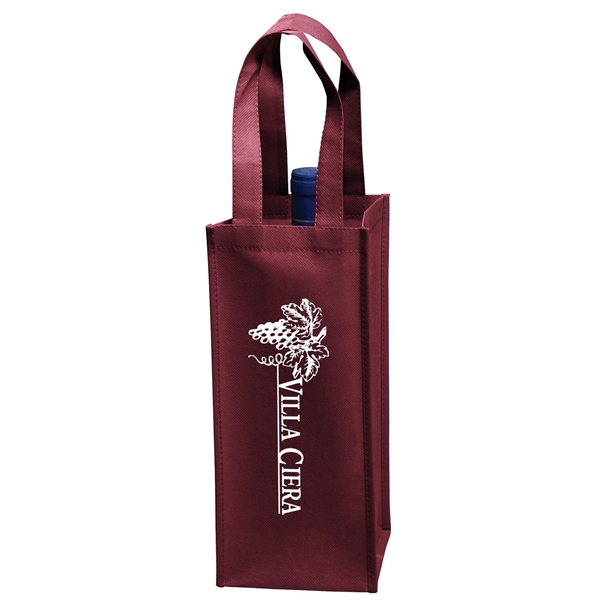
For high-volume tasting rooms, the Single-Bottle Non-Woven Wine Tote Bag is the entry point: 80 GSM non-woven polypropylene, priced from $0.89 at the 200-piece minimum and dropping to $0.45 at 5,000 units.
Wine Tote Bag Materials Compared: Non-Woven vs Jute vs Kraft
Material choice drives both the price and the impression your custom wine bags make at hand-off. There are three realistic options, and the differences matter more than most buyers expect.
| Material | Look and Feel | Typical Bulk Cost | Best For |
|---|---|---|---|
| Non-woven polypropylene (80–100 GSM) | Smooth, matte, lightweight | $0.45–$2.15 per unit | Tasting rooms, festivals, high-volume retail |
| Natural jute with display window | Textured burlap, premium, label visible | $1.50–$2.42 per unit | Wine clubs, weddings, upscale gifts |
| Single-use kraft paper | Disposable, no reuse | $0.10–$0.30 per unit | Bags recycled within the hour |
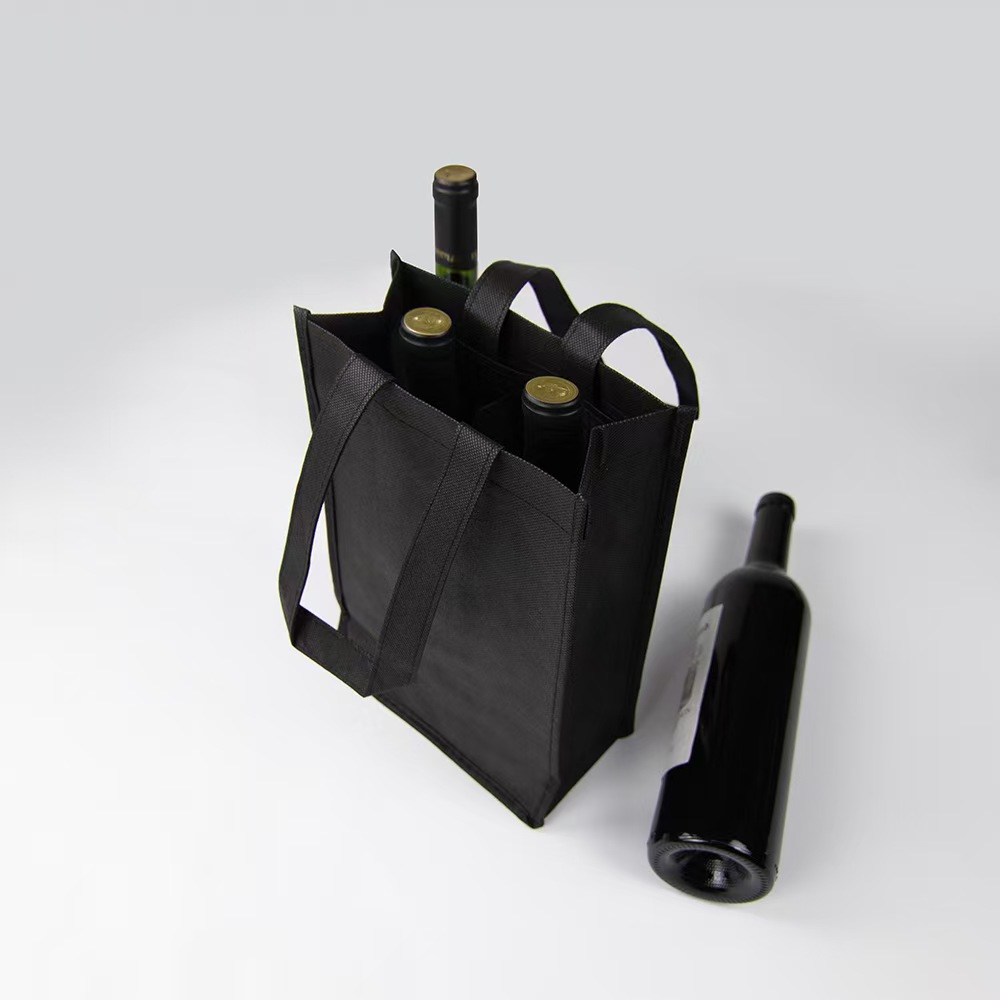
Non-woven polypropylene is the volume workhorse. Fabric weight — measured in GSM (grams per square meter) — determines how the bag feels: 80 GSM is light and economical, while 100 GSM reads as sturdier and holds up across a full season of reuse. It also provides one of the smoothest print surfaces in the bag world, which is why screen-printed logos come out crisp at up to four colors. The Double Non-Woven Wine Tote Bag is the category's workhorse for a reason: a sewn-in center divider keeps two bottles from clinking in transit, at $1.30 per unit from the 100-piece minimum.
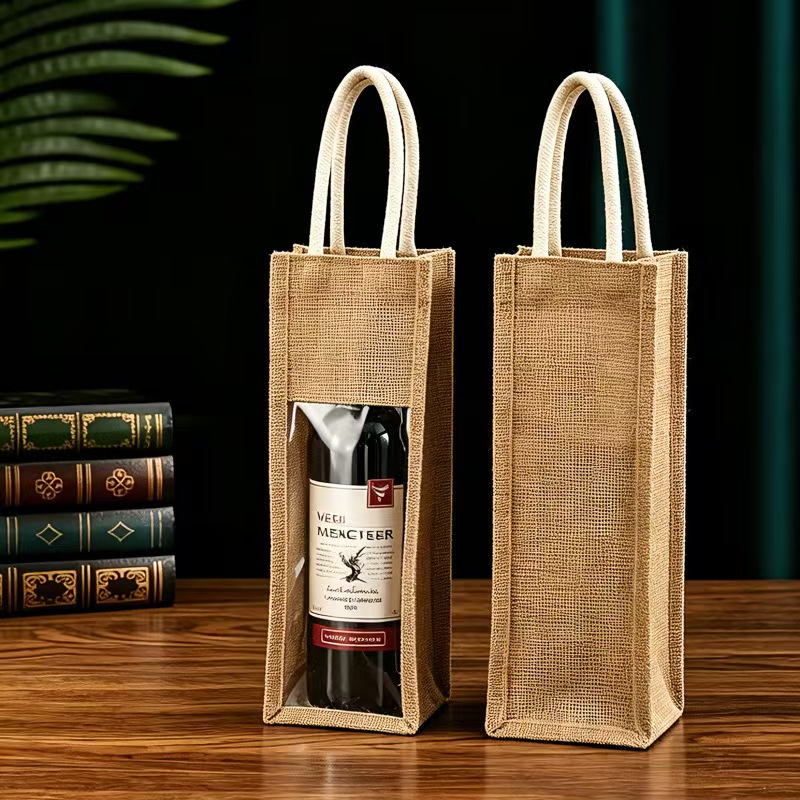
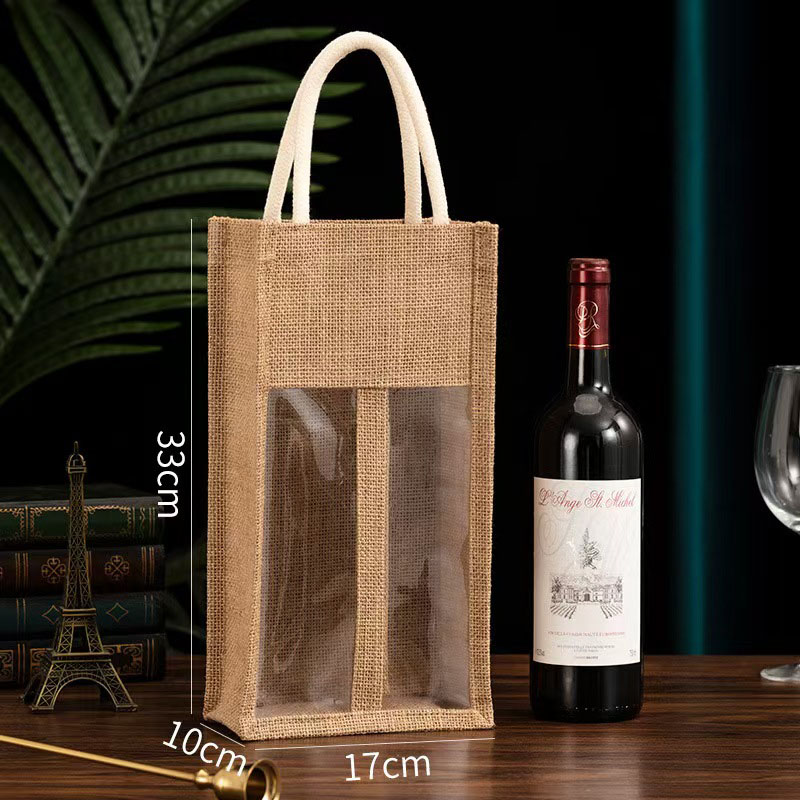
Jute plays a different position. The woven natural fiber has visible texture that photographs like a $30 gift, and a clear PVC window lets the bottle's label show through — so the wine markets itself while your logo rides alongside. The Jute Double Wine Bottle Tote Bag with Window is the premium choice for two-bottle gift sets, from $2.42 at 100 units down to $1.75 at 2,500.
For a broader walk-through of bag fabrics, weights, and construction, see our complete guide to custom tote bags.
How to Choose the Right Size Branded Wine Bag
Capacity is the most practical decision in the whole purchase, because it maps directly to how your customers actually buy wine.
| Capacity | Best-Fit Use Cases | MOQ | Opening Unit Price |
|---|---|---|---|
| 1-bottle | Tasting room sales, single-bottle gifts | 200 | $0.89 |
| 2-bottle | Paired purchases, wedding favors, host gifts | 100 | $1.30 |
| 4-bottle | Sampler packs, club tier pick-ups | 100 | $1.79 |
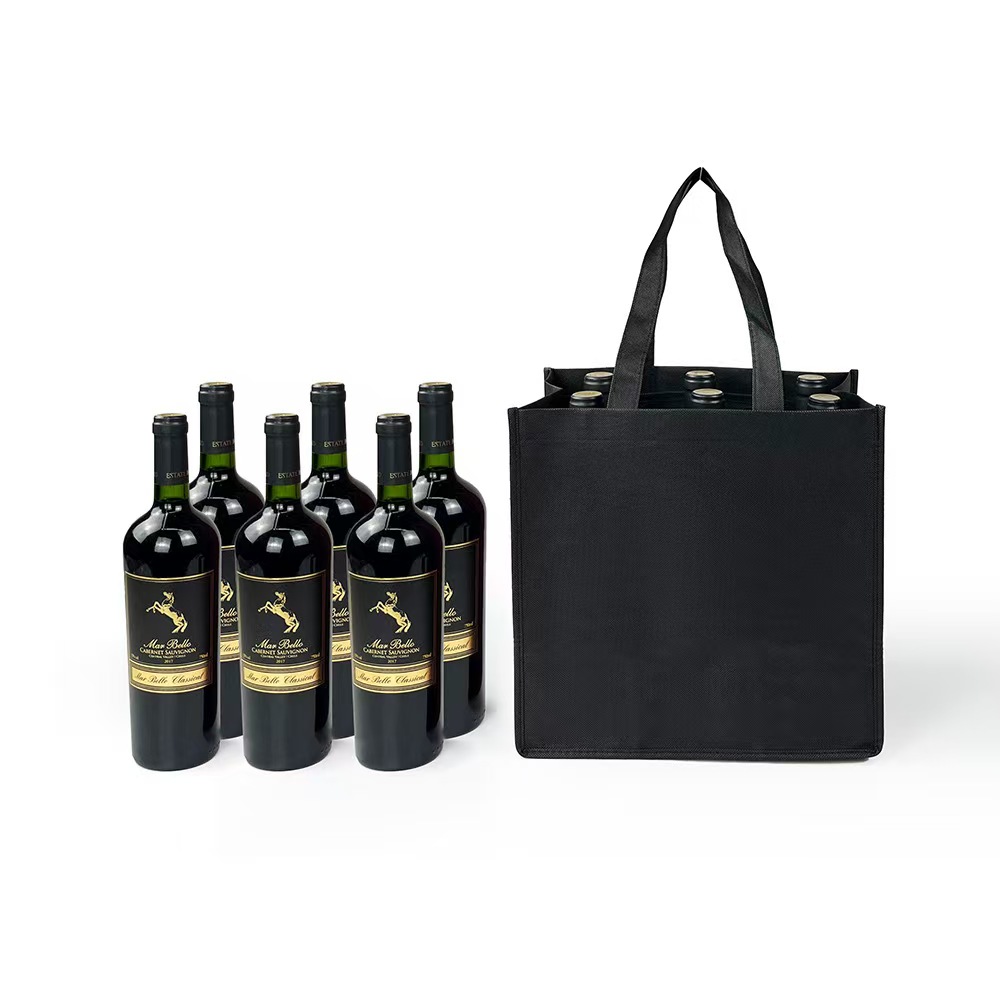
| 6-bottle | Full case carry-outs, holiday corporate gifts | 100 | $2.15 |
Two sizing rules hold across nearly every winery program we see:
- Match the bag to your best-selling transaction. If your average tasting room sale is two bottles, a two-bottle tote with a center divider fits the purchase exactly — no wasted capacity, no awkward extra room.
- Match the bag to your club allocation. A club that picks up four bottles per quarter should brand the 4-bottle tote; members then reuse it every quarter, carrying your logo back through the winery gates.
The multi-bottle styles earn their price premium in construction: the 4-Bottle Non-Woven Wine Tote Bag uses separate compartments so bottles never touch in transit, and the 6-Bottle Non-Woven Wine Tote Bag adds divider pockets plus a front slip pocket — handy for a club newsletter or recipe card at pick-up events.
Where Promotional Wine Bags Work Hardest
Different touchpoints call for different tiers of promotional wine bags. Here is where the format consistently outperforms:
Tasting rooms and wine festivals. Volume settings favor non-woven totes at sub-$1 pricing — cheap enough to hand to every buyer, durable enough to survive a full season of reuse. At outdoor wine festivals, your bags double as walking signage across the grounds, and the distribution tactics in our trade show giveaway guide apply to festival booths almost unchanged.
Wine club allocations and pick-up parties. Club members are your highest-lifetime-value customers, and the allocation bag is a quarterly touchpoint you already pay to fulfill. Upgrading it to the Jute Single Wine Bottle Tote Bag with Window — natural fiber, label visible through a clear display window — turns a routine hand-off into an unboxing moment members photograph and post.
Weddings and private events. Couples planning wine-country weddings order two-bottle totes as welcome bags and favors by the hundreds. Jute styles dominate here because the burlap texture photographs beautifully next to florals, and the clear window shows off a personalized vintage label.
Corporate holiday gifting. Wine remains the default corporate gift, and a six-bottle tote with your full logo converts a generic case hand-off into a branded presentation that survives into the new year. Q4 is the peak season for this channel — more on timing below.
How to Print Your Logo on Wine Bags
Every wine bag in this guide accepts screen printing and heat transfer, and most styles support up to four print colors. Between the two methods:
- Screen printing — the standard for non-woven totes; razor-sharp on the smooth polypropylene surface, most economical at one or two colors, and durable enough for a bag that gets reused weekly
- Heat transfer — the better choice for multicolor or photographic artwork, since it lays down the full design in a single pass
Artwork guidance is the same for either method:
- Lead with your primary logo or wordmark, sized to read across a tasting room bar
- Hold to one or two colors where possible — bold contrast prints beautifully on natural jute, and full color pops on white non-woven
- Add one line of contact: website, QR code, or tasting room hours
- Simplify art for jute — the textured weave rewards big, clean shapes and swallows fine detail
For a full comparison of imprint methods, including setup fees and cost per color, read our imprint methods explained guide. The Double Non-Woven Wine Tote Bag is the most print-friendly canvas in the lineup: a smooth 100 GSM face with generous room for a logo plus a website line.
Budgeting Bulk Wine Bags: MOQs, Tier Pricing, and Lead Times
Factory-direct bulk wine bags start at a 100-piece minimum for most styles (200 for the single-bottle non-woven tote), with tiered pricing that rewards volume:
| Order Quantity | Single-Bottle Non-Woven | Jute Double with Window |
|---|---|---|
| 100–249 | $0.89 (min 200) | $2.42 |
| 500–999 | $0.65 | $1.96 |
| 1,000–2,499 | $0.59 | $1.85 |
| 5,000+ | $0.45 | — |
Run the practical math for a tasting room moving 4,000 bottles a year: a full year of branded two-bottle totes at the $1.30 opening tier costs less than one weekend of boosted social posts — and the bags are still advertising next summer.
Lead times run 2–4 weeks for production after proof approval, plus shipping. That makes Q4 the one hard deadline in this category: place holiday corporate gifting orders by early October to clear proofing, production, and freight before December, and give harvest-season festival orders the same cushion against September bottlenecks.
Recommended Products
These five styles cover the full range of wine marketing touchpoints, from festival volume to club-tier gifting:
- Single-Bottle Non-Woven Wine Tote Bag — the sub-$1 volume choice for tasting rooms and festival booths
- Double Non-Woven Wine Tote Bag — the best-selling two-bottle format, with a center divider that prevents clinking
- 6-Bottle Non-Woven Wine Tote Bag — built for full case carry-outs and corporate holiday gifts, with a front slip pocket for inserts
- Jute Single Wine Bottle Tote Bag with Window — the premium club-allocation upgrade that keeps the label visible
- Jute Double Wine Bottle Tote Bag with Window — the wedding and gift-set showpiece with upscale burlap texture
Ready to turn this season's carry-outs into next year's tasting room visits? Contact your promotional products distributor to request samples and compare imprint options before your next order window closes.